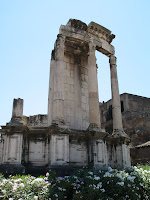
Showing posts with label Italy. Show all posts

Friday, January 18, 2013

Breaking Up Is Hard To Do


Yesterday was the anniversary of the date in 1377 when Pope Gregory XI moved the papacy from Avignon, France, to Rome. It stands to reason, however I have little evidence to support it, that today must be the anniversary of the date in 1377 when the pope had his cable turned on and unpacked his record collection.

Gregory and his small retinue of hundreds moved into a charming fixer-upper and proceeded to plan his vegetable garden and to innovate new ways to torture heretics. The house immediately became a magnet for Rome’s cognoscenti, literati, and illuminati. Unfortunately for the thirty-second most unoriginally named pope (all of the Johns (including an antipope (John XVI) and a non-existent pope (John XX)) and the first ten Gregorys are ahead of him), he died not long after his move, leaving his garden plan unexecuted (but not a few heretic--they WERE executed) and casting all of Catholicism into a lengthy spat.

Before I get into The Great Schism, I would like to revisit the fact that there is a nonexistent pope. Somehow the papal historical record labeled one of their honchos incorrectly. John XIV was apparently counted twice (perhaps due to the action of another antipope, Boniface VII (sometimes the history of Western religion reads like a Marvel comic book: Pope/Antipope)).  I am not kidding when I tell you that the papal record apparently refers to John XIV AND John XIV the second.  How can you have a John XIV the second?  Isn’t that like having a John Jr III?  It doesn’t make any sense.  But, when the pope who would be XX came around--a guy referred to as (again, no joke) Spanish Peter--he decided to correct the record (assuming there already had been XX popes named John) and he skipped the XX and went right in as XXI.  As it turns out, John XIV and John XIV the second turned out to be the same guy.  Um, duh?  No wonder some Christians believe the world is only 6000 years old--they can’t even keep track of sequentially numbered guys named John.

But, anyway, the pope elected after Gregory XI was from Naples, and the French, being used to a) having a short walk to the pope’s house (pre-1377) and b) speaking French to the pope (okay, you got me, it was probably Latin, but there’s no joke there…is there?), did not like the new guy. So, they did what any reasonable collection of people will do when an election doesn’t go their way—they split. Literally. And, so, The Great Schism began, and Europe had to choose a patriarch. This was highly confusing to Europe. The pope was supposed to be the closest human to God, and now there were two?  How could that be right? As it turned out, most of France and Scotland went with the antipope in Avignon, and everybody else sided with the Neapolitan pope.

For thirty years, cardinals tried to solve the problem. The best solution they could come up with occurred in 1409, when, in an attempt to sort out who was the legitimate pope, they elected a second antipope, giving them, you guessed it, three popes to choose from! I have no idea how they managed such an unbelievable act of incompetence.  Maybe they thought they were voting for one thing and voted for another? Perhaps the ballot was printed in too small a print, or it was written in the vernacular (which they did not understand). Be that as it may, the episode of The Great Catholic Comedy from season 13 titled “Aw, Schism!” began to rival the most madcap episodes of I Love Lucy ever filmed at DesiLu Studios.

Eventually, the cardinals figured out the difference between one pope and three popes (or one pope and two antipopes), and they recognized the legitimacy of the Roman “line” of popes. They call it a line, but that would imply heredity, wouldn’t it?  Are only popes allowed to reproduce? I will stop this line of inquiry here, I don’t want to upset too many of my family members.

Needless to say, the Roman popes eventually moved out of Gregory XI’s little cottage and started their own city-state, Vatican City. Hmmm, city-state. Didn’t the Greeks have city-states? And wasn’t there a big break up between the Greek and Latin Church in 1054? And wasn’t that The Great Schism? Does that mean we should refer to the 1377 break as The Great Schism the second?  And, really, y’all, what’s with all the schisms? Can’t we all just get along? 

Saturday, September 22, 2012

A Rose by Any Other Name

"Chiara," according to everyone's favorite fact checking site, Wikipedia, is an Italian word meaning "clear."  There are several people with this word as a first or last name, and "Chiara" even forms a morpheme of the Italian surname Chiaramonte, a noble Sicilian family who claim descent from Charlemagne.

I tell you all this because a pair of encounters with said word in this morning's Lincoln Journal Star sent me a-searching for some information on this word.  The two usages, both as proper nouns, referred to apparently different things, and, I was certain, different ideas, and, being the curious life-long learner that I am (and having the power of the Interwebs at my fingertips), I did a little researching.

First, my initial encounters.  Ironically, perhaps, both of my encounters with the word occurred in the "fluff" section of the paper, "The (402)."  I believe I have mentioned this section before, so I will spare you my rail on that particular section's ridiculous name.  However, in the "At a Glance" feature, on page F2, where some events are listed and written about briefly, a headline reads: "Walk to conquer Chiara is at Holmes Lake Park."  The article explains that a fundraiser walk will be held "in an effort to bring awareness and funds to Chiara malformation."

The article further states that Chiara is "a neurological condition in which the brain descends out of the  skull and puts pressure on the spine." Really?  That actually happens to people? Their brains fall out of their skulls.  Why?  How?  It sounds like an awful condition.  Of course, it is, I thought to myself. Why else would they need to raise funds or awareness? Nobody would be interested in a Stubbed Toe 5K, would they?  Who would pay $25 to race in a Pretty Bad Stomach Flu Fun Run?  We only tie up our Mizunos for big causes, like cancer, muscular dystrophy, or chiara, to name just a few.

As I turned the page, I found on F4 a review of a recent chamber music performance: "Chiara members open Sheldon Friends season."  I have heard of this Chiara Quartet, two men and two women, who are well-known in the chamber music circles.  They have made many appearances here in the Lincoln area, always to great acclaim.  But this review, published so close to and on the same day as the fundraiser walk, stoked my inquisitiveness.  I needed to make sure that these chamber players weren't being highly insensitive, naming themselves after a neurological condition suffered by "about 300,000 people in the United States."

And, so, I was led to the Wikipedia, where I find listings for celebrities named Chiara, saints and singers, physicists and attorneys. I find the names of churches and a "religious complex" (don't you mean a "church?").  And, I find links to the aforementioned "Chiaramonte" and a pair of words that are homophones of "chiara," itself.  What I don't find is any mention of any neurological condition.  I had to search the Google a bit more to find any discussion of dropped brain syndrome (an alternate, totally rad, name I have given to the condition, myself), but I did find some information about the condition that affects more people in the US than live in Barbados.

(Interestingly, the website Researching Virtual Initiatives in Education, on their page "All Countries by Population," divides countries using "'scientific' nomenclature." For instance, a country with at least 1000 million people is a "kilostate;" a country with at least 0.3 million but less than 1 million is a "tridecistate" (also known as a minicountry); a country with less than 0.01 million people, a picocountry, is a "millistate." There are also "centistates" and "hectostates," orthocountries, nanocountries, and gigacountries.  Another bit of information learned on this random research project.)

But, back to "chiara."  I learned a lot in the several minutes I spent researching this little mystery, but I was left with a few questions. First, I wondered where the quartet came upon their name?  Is it a tribute to a person, or a place (most likely a church)?  I also wondered if they were even aware of their close association with a leaking skull?  But, more importantly, I wondered how, if the Chiara fundraising initiative was sophisticated enough to organize multiple events such as this weekend's 5K walk, they were unable to draft as valuable a PR tool as a Wikipedia page? Because, when you think about it, not everybody is going to be as dogged a researcher as I have been today.  If people don't get their wiki-fix on the first search, right at the top, they'll go right back to looking for topless pictures of Ryan (Hey, girl) Gosling.  And, if you're trying to drum up support for a disease or a condition, you have to do one of two things: make sure a lot of people suffer from it (i.e., cancer) or that a lot of people know about it (i.e., muscular dystrophy).

Finally, if I were in a string quartet, and I found out it was named after a neurological condition that can lead to deafness, dizziness, double vision, eye pain, headaches, and spasticity (I did not make this word up), I might just change my name to Cancer.


Wednesday, June 16, 2010

Sitting Still

In 2006, Monkey and I spent part of June in Maine. In 2007, Monkey and I spent part of June moving from CoMO to Lincoln. In 2008, Monkey and I spent part of Jun in Italy. Last year, Monkey and I spent part of June in OCMD. This year, we aren't going anywhere.

For the most, we are staying put this month due to our new puppy. We will be heading to Colorado at the end of July, but, right now, we think he's a little too young to be left in the care of someone else (especially if he'd be around strange dogs). This is, after all, his formative period, and we wanted to be here to form him, of course.

It's fine by me to be keeping close to home. I find plenty on the old homestead to keep me busy, including reading (of which I have done too little, so far). Add to that that World Cup eating up anywhere from an hour to six of any given day, I am perfectly content to be here.

In a way, however, I am traveling. After three years teaching at my school, my position was cut due to budget tightening. As a result, I spent several weeks this past semester interviewing with other schools in the district who, due to transfers, resignations, retirements, etc., had openings. Lucky for me, a high school position was available, and I was offered it. So, I am moving to a new school next year. I am still in the LPS district, so I keep all of my seniority and such, but I still had to pack everything up and store it here until I can get into my new location.

It is frustrating to lose a position for such arbitrary reasons, but I feel fortunate that I didn't get laid off and left to fend for a new job in a completely new district. That would have really been tough. I am, to some extent, looking forward to the excitement of a new school and new classes.

Yet, staying in one job for a while wouldn't have been bad, either. That seems to be something I haven't done for a long time. And, now that I think about it, the last time I was in the same job for a long time (ten plus years), I kind of grew to hate it.

Wednesday, July 08, 2009

The Personal Connection

A year ago this time, I was regaling you with the long story of our trip to Italy. I have been thinking a lot about this trip, since it was such a wonderful experience, and we are at that point (an anniversary) when the human mind tends to reflection. In addition, I am currently reading Salman Rushdie's The Enchantress of Florence, which takes place in Renaissance Florence (and 15th century India, as well). It is an enjoyable read, thus far, and far more accessible than I expected (I'd never read Rushdie before), but the most exciting aspect right now, for me, is his description and mention of places in Florence that I have seen with my own eyes.

I always spend some time discussing with my students the strategies that good readers use. One of the primary strategies in comprehending and enjoying any text is making a personal connection, finding something in the text that you can equate in some way with your own life experiences. As I read the first section of the novel, which takes place primarily in India, I was making connections, but, for the most part, those connections were between the text and some other text I had read or seen, but, once the story shifted locales, the novel has taken off. When Rushdie writes of the burning of Savanorola in the Piazza della Signoria, I can picture the square exactly as I saw it (and imagine the Dominican monk horridly en fuego in the center of it). It is a vivid reminder of the power of personal connection and a pleasant stoking of the memories of a place that I hope to one day visit again.

Wednesday, December 03, 2008

Central Standard Guide to What's In for 2009

As a highly sought after arbiter of taste, it is my duty to keep my readership aware of the most trendy things for the new year. After all, who wants to be seen wearing last year's beard, or an outdated button-down Oxford? Who wants to visit the greasy spoon that is so declasse (I have no idea what that means)? Or listen to unpopular music from the 90s...omg!

So, I will spend the month of December irregularly updating you on what is in for the coming new year, and what is out from the old year. Let us begin.


IN: Spain

Monkey and I are in love with Tempranillo, a hot Spanish wine. Had we any money in reserve, we would be off to Seville, Barcelona, Madrid, in a heart beat, truly living the Hemingway-esque expatriate life. Alas, it is not to be. Last year's boffo trip to Italy put us out of the running for any but domestic travel (and that, mostly by auto) for the foreseeable future. But, until we are uncorking some fine Spanish wine on the shores of the Mediterranean, this is the place to WANT to be.


OUT: Italy

Mi dispiace, Italia. However, that was sooo last year.

IN: 40

It's the new 20! How many MIPs can I rack up before I turn 41?

OUT: 30s, 20s, teens, tweens, toddlers, infants, newborns

As Tony's boss tells him in Saturday Night Fever: "You don't fuck the future. The future fucks you."

Stay tuned for more....

Friday, July 25, 2008

Vatican City and The Tour de Churches (A Very Long Italian Story, Part the Last)

First, my apologies for the abrupt hiatus that this long story took on Thursday last, but an impromptu trip west took us away from our computer for a few days. Now, we are back, prepared to finish this tale, update all on the goings on since our return (pasta making!) and to tell the tale of our recent westering.

Second, I am surprised that no one called me on the fact that I referred to the Pantheon as the Parthenon in my last post. Boo to all of us. The Parthenon is in Greece.

Our last installment will cover the last two days of our Italian tour, a visit to Vatican City on Monday, and a whirlwind of churches on Tuesday. The departure on Wednesday was a bit of an adventure, also; maybe we'll make that an Epilogue.

The Vatican tour began, as all our Roman days did, at the bakery, sipping espresso and eating pastries (why would we want to leave?). From there, we hopped on the Metro and were quickly deposited on the other side of the Tiber, just a short walk from Vatican City.

St. Peter's Basilica and the Vatican Museum were our main objectives on this day. We crossed the long sun-drenched piazza outside the Basilica and entered the dark church. It was big and ornate, as you might expect. Turning each corner seemed to reveal a pope interred in a glass sarcophagus, and most walls held beautiful replicas of Renaissance paintings done in mosaic. You could hardly tell they were mosaics, they were so exquisitely done.

Of course, the biggest draw, for me, was Michelangelo's Pieta, which occupies a small chapel near the Holy Door (which is only opened during Jubilee years (four times each century). As I stood there, gazing through the glass partition at yet another Michelangelo masterpiece, a couple came up next to me, jostling through the crowd. The woman, shorter than the man, stood on tiptoes, but still could not see.

"What is it?" she asked the man.

"Eh, it's just a scuplture," he said, as they walked away.

Just a sculpture? Some people.

We proceeded down into the crypt of the Basilica, where the tombs of many ancient popes are located. It is interesting to see whose tomb is simple and whose is ornate (by order of their own "living will").

From the crypts, we headed a few blocks down the main drag to have some pizza, then walked back to the museum. We had about three hours to tour the museum, which contains so much art and so many artifacts that it takes several days to really see everything. We headed right for the Sistine Chapel. The chapel itself was beautiful, amazing, breathtaking. The experience of getting there and being there, which is similar (I imagine) to being herded like a steer through some passage ways and then corralled, was not so wonderful.

We then whizzed our way through some of the paintings (good stuff), before heading back home to get ready for dinner at a little place called Pasqualia's (I think). Dinner was okay, but the real treat of the evening was the after dinner walk we took through the heart of Rome, from Campo del Fiori to the Trevi Fountain and the Spanish Steps. It was such a different experience seeing these famous sights under the moon light.

The next day, after a final stop at the bakery, where Monkey felt like a regular when she exchanged some greetings with one of the counter girls, we made a tour of nine churches. From Santa Maria Maggiore, with its early Renaissance mosaics, to St. Peter in Chains, with its Moses by Michelangelo and its relics of St. Peter, we made our way. Next, we visited San Clemente, where underground excavations reveal the structure and artifacts of a thousand year-old place of worship (but, we got there too late to visit the archaeological area), then proceeded to San Giovanni in Laterno, the basilica of Rome.

San Giovanni seems to want to rival St. Peter's Basilica (the basilica of Vatican City), but, it just can't (and it shouldn't try). One of the oddest things I witnessed on the whole trip was a crowd of people standing near the altar, throwing coins at (what might have been) a tomb covered with Plexiglas. Never did figure out what that was all about.

The Pantheon was next, but only to have a slice of pizza on the steps, before we toured San Luigi dei Francesi. This church, built by French Catholics, contains a statue of Jean d'Arc, some intense baroque architecture, and three typically awe-inspiring Carravagio's depicting scenes from the life of St. Matthew. This might have been my favorite church of the day.

Church number seven was San Ignazio, a Jesuit church with some uninteresting trompe l'oeil frescoes on the ceiling, and a strange wooden model of a "world church" or some such fantastic toothpick idea. It's possible that our poor assessment of San Ignazio was due to the next church we visited, Chiesa del Gesu, whose baroque ceiling included a spectacular fresco of the Last Judgement that made it appear (in a very Michelangelo sort of way) as if people were actually falling from the ceiling.

Our last church was Santa Maria Sopra Minerva, the only Gothic church in Rome. Here, we viewed the remainder of the remains of St. Catherine of Siena (remember, her head and thumb are in San Dominico in Siena), as well as one last Michelangelo, a marble Jesus carrying the cross with bronze accents. A very realistic and human-looking Jesus, but then, what DO you expect from Michelangelo?

After our marathon of churches, we were ready for some fine fare, which we enjoyed at a little place near Santa Maria Maggiore. Our last meal in Rome was definitely our favorite. A fine way to finish up before a 3 am wake up call to catch a taxi to the airport to begin our long journey home.

Thursday, July 17, 2008

A Loss For Words (A Very Long Italian Story, Part Fifteen)

Our first morning in Roma took us to Pannella, a little bakery down from Santa Maria Maggiore (a big ol’ church). It was a wonderful little shop, with some tasty goodies (including the hot out of the fryer donut I had for breakfast) and excellent espresso. Monkey and I visited here each morning we were in town.

Proceeding (afoot) to Palatine Hill, we purchased tickets for there and the Coliseum, then walked over to the Coliseum to start our sightseeing day. It’s hard to really say anything that doesn’t seem pedantic about the Coliseum, so, I’ll just post some pictures.


From the Coliseum, we went over to Palatine Hill, where the Roman emperors used to build their homes (this place is where we get the word “palace”). This was amazing, a huge area of ruins: walls and foundations, steps to nowhere, vistas. Wow. And, as an added bonus, from an overlook, you can see the remnants of the half-mile-long Circus Maximus, where the Roman version of Carl Edwards (Karlus Edwardii) and Tony Stewart (Antonius Caesar) once did their things with chariots.

From the hill, we descended into the Roman Forum, another place where description would fail miserably. So, visuals.


We left the Forum, and wandered more of Rome: Capitoline Hill, designed by Michelangelo; the Victor Emmanuel Monument, the massive white structure that Romans call the “false teeth;” Palazzo Venezia, where Mussolini would address crowds in the street from the window above; Trajan’s Column, with a statue of St. Peter where Trajan used to be; the Pantheon, a spot we would come back to every day we were here, and lastly, Trevi Fountsin, where it appeared everyone else in Rome had decided to go, as well. Very crowded little piazza.

We shuffled back to the apartment, and then walked down to the Coliseum area for dinner. However, the restaurant where we wanted to eat was closed (it was supposed to be open, according to their hours). We suspected that the owners decided to focus on the quarterfinal soccer match with Spain that evening. So, we headed to another restaurant that we had been informed of, Trattoria di Quadranto. The pictures on the wall showed that this establishment had been here for at least eighty years, so, we figured that as a good sign.

We learned something very important at this restaurant. Monkey ordered a pasta with a gorgonzola sauce. It turns out she doesn’t like gorgonzola as much as she thought. So, not wanting to leave a full plate of food in front of us, I ate her pasta, and my fried cod (this after a primi, also). I was stuffed!

We had flirted with a night walk, but, after the day's marathon, and my distended belly, we decided that we’d walk to a gelateria (for Monkey—none for me…okay, maybe just a little taste), and then head home. That would be enough of a walk, and we’d save the romantic evening stroll for another time. Like tomorrow, after we got back from visiting the Pope’s house.

Desperately Seeking Marcus Aurelius (A Very Long Italian Story, Part Fourteen)

The last leg of our Italian journey began as we settled our bill, loaded up the Punto, and headed east to the unknown streets of Chiusi, where we were contracted to return the rental. Our drive to Chiusi was uneventful, if not beautiful, but, as we arrived in town, we were in the midst of the most half-baked plan of any we had devised on the entire trip.

All we knew about the rental office was the address (82 Via Marcus Aurelius). Along with us, we had no map, no Garmin, no directions. Just the address and the assurance from the office in Firenze where we picked up the car that the location was “downtown.” So, as we approached Chiusi, we tried to figure out where “downtown” was. We stayed on the main road, thinking that would lead us into the bustling interior of the urban hive that is Chiusi. The main road took us into the centro storico, instead, the old town, with the tiny streets and the cobblestones.

We were on a sort of deadline, too, needing to return the car before 11, or we’d get charged for an extra day. We had already decided that the short drive to Chiusi had not used up enough gas to label the tank “not full,” so we didn’t fear any fuel charges, but we didn’t want to tack on any penalties, if we could avoid them, and being charged for a whole day when you only had the car an extra fifteen minutes because you were turning circles trying to find the place where you were supposed to drop the car off for an hour plus seemed to us like a height of stupidity to which we wished not to soar.

In the middle of our turning and turning and backtracking and neck craning and street sign reading, we were forced to turn into a parking lot, in order to turn around. I remembered that many of the parking lots we had visited in these smaller towns had large maps of the towns in them, and I spied one as we turned in. I hopped out as Monkey pulled the car out of the main traffic area. After a few moments looking at the map, I found our street, which wasn’t far away. I hopped back in the car, and we headed that way.

We found the road pretty easily, but, as we drove along, watching the numbers, we seemed to drive right by 82 (with no markings of it anywhere). There was 78. There was 81. There was 90. What happened to 82? We knew that in Italy, the residences and the business each had different colored numbering systems, and it was perfectly natural for a business 82 to come just before a residential 34, or after a 126, so we kept driving. Then, as streets often do, Marcus Aurelius took a quick turn, leaving us on a street we did not want to be on, so, we swung around and got back on. A few blocks later, Marcus Aurelius seemed to disappear altogether.

But, we were clearly in a downtown-like area. We did a few turns (and maybe broke a few of those phantom Italian “traffic laws”). We passed the train station, where we needed to ultimately be to get a train to Rome, and, then, as if on cue at the lowest ebb of hope and highest tide of despair, we turned inexplicably back onto Marcus Aurelius, only two store fronts from the Eurocar office.

As we pulled up, the Eurocar rep was getting into a car.

“One moment,” he said, and drove off.

We sat on our luggage. It was 10:45. At 10:55, he did return with a cup of coffee. We checked in with no problem and walked over to the train station to wait for the train to Roma.

Our tickets to Roma cost 16 Euro each. This was a great difference between our tickets to Firenze from Milano, which cost 36 Euro each. We wondered if we had the right tickets, but, as we waited for, boarded, and rode the two hours south, nobody accosted us.

We got off the train in a very hot Roma, walked the three blocks to our accommodations, where they held our luggage, because we couldn’t really occupy our room until 3pm. So, with map in hand, we wandered the streets of Rome, beginning a trend that would continue for the remainder of our trip of walking (nearly) everywhere, covering miles each day, and consuming gallons of aqueduct supplied public water.

We planned our tomorrow: Coliseum, Palatine Hill, Roman Forum, and then got previews of a few of those places. One side note on Rome: I may have mentioned in a previous post that I was nervous about Rome, since I have a sort of loathing of large urban areas (maybe loathing is too strong a word…), but, for the three days plus that we were there, I rarely, if ever, felt the same way as I have described feeling about Chicago, or San Francisco, or Baltimore. I don’t know why, but, my enjoyment of Rome was not in the least hampered by my own paranoid hang ups, so, hooray for me, I guess.

Tuesday, July 15, 2008

Taking It Easy (A Very Long Italian Story, Part Thirteen)

And so, we come to our last full day in Tuscany. We decided to make it an easy-going day, and slept in an extra hour before heading to breakfast. After a leisurely cappuccino, we spent some time at the apt reading up on any last minute places we wanted to head. Monkey wanted to visit a little town called Montechiello. We also decided to spend some time visiting a town we had passed each day in our Tuscan travels, San Quirico d’Orcia.

San Quirico was our first stop. Once into the town, our first stop was a small church with a little well outside of it. It was very rustic on the outside, and not very interesting on the inside. We spend about ten minutes inside. We then proceeded to the town gardens, which were described to us in a guidebook as “a fine example of a boxwood hedge” (I am paraphrasing, here). When we entered the garden, it was a ten by ten paved yard, with a couple of weak-looking shrubs. This wasn’t a “fine example” of anything. Undaunted, we walked up a little stone stairway and through an arch that led to some tree-lined paths. After some cool wooded strolling, we came upon some dilapidated fortress walls and, eventually, the actual boxwood hedges. And, yes, they did seem pretty fine to this boxwood hedge noob.

We strolled down to the piazza and visited a church known as the Collegiata. It was a white marble, with the unique feature of having three doors, two of which still contained the original sandstone columns and lintels from the original 1000 year–old church. Inside, the church is pretty bright (for a church in Italy, anyway). The interior was done in light colors and the décor was light colored, as well. Not much in the way of priceless art, but, while we were there, it seemed that a local artist was showing off his newly created rostrum and Stations of the Cross in sandstone.

After checking out a few shops in San Quirico, we headed down to Montechiello. There was not much doing here. It was a beautiful little town, and, much unlike yesterday’s “Tuscanyland,” there was not much in the way of tourists. We spent most of our time in Montechiello (which wasn’t much), just wandering the tiny twisting streets, and listening to the sounds of lunch being made coming through the windows above.

On the way back from Montechiello, we stopped in Pienza to pick up some wine for a light lunch of leftovers back at HQ. After lunch, we lazed about, until dinner (for which we had reservations) at Latte di Luna. Then, it was off to bed, since tomorrow would bring a drive to Chiusi and a train ride to Roma.

Tuscanyland! (A Very Long Italian Story, Part Twelve)

Our second day in Siena proved that one learns from experience, as our time spent maneuvering within the city limits and securing a parking space was much reduced from the previous day. Like mice in a maze, we clearly remembered where to go to get the cheese. The cheese in this case being, of course, a parking spot.

We visited some more museums, and were thrilled at the sights of Donatello’s tondo of Madonna and Child (not our contemporary Madonna and her adopted baby, but the Biblical Madonna and her baby, Jesus), as well as Duccio’s Maestra and Passion. The real treat was that we stumbled upon a museum guide/art historian giving a lecture on Duccio’s works. It was enlightening to say the least. I know a little bit about art history, but this was a tour de force of a lecture! And, it was in English—score! Really illuminating.

We also spent a little while in Il Crypta, the remnants of the eighth century church on which the Duomo is built. It was okay. Lots of frescoes and brick arches. Our next stop in Siena was Il Facciatone, the remnants of what was to be the façade of the actual cathedral.

Remember yesterday, I told you about the rivalry between Firenze and Siena? Well, in the 1300s Siena had planned to expand their cathedral, which was completed in the middle 1200s. The gargantuan expanded cathedral would have been many times larger than the relatively large structure that they have now (and waaaay bigger than Firenze's). However, after building the façade, the plague hit Siena, and work was halted, never to be resumed. So, now, they have a giant wall (with a good view), and some white marble pavers to show visitors where the columns would have gone in the Olympic-sized transept of the planned Uber-cathedral.

After some pretty tasty pizza, we headed over to the Oratorio di San Francesco, to visit one last Senesi museum. This one, also a diocesan museum, was loaded with church art, from the 12th century to the 19th. Not bad, though I can’t recall anything that I found particularly breath-taking, here. Then, it was back to the cheese (I mean parking space), to head over to Volterra, via San Gimignano.

We had planned on heading directly to Volterra, having heard that San Gimignano was kind of a tourist trap. At our pizza fiesta the night before, however, we were turned on to a supposedly world-class gelato shop in the town. So, intrigued, we went. As a side note, this area of Tuscany, the sort of northwestern area of Siena province, is well-known (apparently—I didn’t know it) for its alabaster. Thus, if you are looking for some quality artisanal alabaster, head on up to this area. As it turned out, the gelato at the recommended purveyor was four-star. We sampled peanut butter, rosemary-raspberry, pistachio, chocolate, and banana (I think that covers it). We had seconds, it was so good.

I dubbed San Gimignano, “Tuscanyland” (like Disneyland). It really did have a feeling of a this-is-what-Tuscany-is-like-so-we-hope-you-enjoy-it-would-you-like-to-buy-some-alabaster-or-a-T-shirt-that-looks-like-a-Renaissance-style-doublet? I sort of felt like I had strolled into a Renaissance festival, Italian-style. I would not have been surprised if someone in full Medici garb came wandering down the via with his entire retinue, including a juggling dwarf and a prancing minstrel with a lute.

The drive out to Volterra was a bit longer than we bargained for, but, it was a good side trip. We got to see the first Roman ruins of our adventure, a theatre. Unfortunately, as we arrived at about 5pm, the site was closed, but, fortunately, it is readily visible from the street, and the woman at the ticket booth did let us stand on the overlook inside the grounds (for free). We had a gander at a few other sites of Volterra (Etruscan walls, churches, you know), then headed back to Pienza where we hoped to dine at Latte di Luna again.

But, no such luck. As we approached the restaurant, there, on the sign outside, was a note: “Completo.” No room at the inn. We spun around in a circle a few times, not wanting to admit that we had only one other choice: the restaurant just up the street, Trattoria di Baccus (or some such). It was good enough fare, but Monkey was pretty disappointed. The moral of this story, when you go out to eat in a town with two restaurants, make reservations!

Monday, July 14, 2008

Heads, Thumbs, and Wood-fired Pizza (A Very Long Italian Sory, Part Eleven)

Our next long drive took us northwest, to the Renaissance rival of Firenze, Siena. The drive, on a sort of state highway-type road, was a bit frustrating (as are many a drive on state highway-type roads), since the road was two lanes, and many large trucks were also heading toward Siena. We spent a lot of time behind trucks. Now, the traffic laws in Italy are more suggestions, I think, than actual "laws." And the ones that apply to passing on the highways and byways seem even less than suggestions. The typical Italian driver (it seems) does not know what tailgating is, or, if he or she does, he or she does not recognize it as a hazardous driving activity. In addition, the typical Italian driver (it seems) does not trouble himself or herself with waiting for a straight section of road with good visibility before passing. Their cars, after all, are relatively small, so, perhaps the drivers assume that they need little space in which to execute the passing maneuver. In all fairness, even the most harrowing example of disregard for the personal safety of self and others was executed successfully, but, this sort of positive reinforcement of negative behaviors must catch up with the typical Italian driver on occasion. Yet, we saw no evidence of this. I was able to distill my traffic observations into the overarching principle of Italian driving: when in doubt, speed up. This also led to a corollary: never brake. If you can remember these two rules of Italian driving, then you are well on your way to a successful Tuscan road trip!

Once we arrived in Siena, we discovered that this was no little Tuscan town. We had so much trouble figuring out where we were (not a very good map of Siena) and then finding a parking space, that we may as well have been in an international metropolis, like Rome or Paris. But, after (I kid you not) about an hour and a half of driving around the winding streets of Siena, with the occasional unanticipated 180 degree turn (which is not a U-turn, it's an intersection that sends your car not on a new track 90 degrees opposed to your previous track, but, somehow manages to spin your car in such a way that you begin travelling in the opposite direction from which you were just travelling (It's not magic, by the way, it's just a screwy street layout.)) we found a parking spot, that another random old woman (not the same one from Montalcino) assured us was legal.

There are a lot of old people in Italy. Not that there aren't any young people, but, it seemed like there were more older folk than one typically sees on an American street. I wonder two things about this: one, is it actually true, or was I simply somehow more attune to the "ancient" in a country that has been in the throes of some form of civilization for 2000 years (and left ample evidence of it behind); and, two, why might that be?

The former wonderment needs no discussion. It may be true, it may not. I don't see how it could be demonstrated one way or the other, so , let it be. The latter, however, is an interesting thing to ponder, maybe. Are there more old people in Italy, or are they more active, or more public? Or, do young people just age amazingly quickly in Italy, and the preponderance of the aged was merely a preponderance of thirty year-olds with graying hair, poor posture, and a penchant for brown suits and patterned mid-length dresses? Now that I have begun this discourse, I find that this is an unsolvable mystery, as well, so, let us move on.

Siena. A lovely town, really. We will spend some part of tomorrow here, as well. Our first stop today was a church (go figure), San Domenico, which holds a few creepy relics of Saint Catherine of Siena (a local virgin who lured the pope to Rome (I am guessing not by using here feminine guile, but then, who knows...)). The town is big on Cathy, and her home is still standing and open for visits (however, nearly every square inch of it has been remodeled into a chapel (Here's the chapel where she received her stigmata! Here's the chapel where she cooked the polenta! Here's the chapel where she used the chamber pot!). San Domenico, which dates from the 13th century, is proud of its connection to Catherine. Here in this church, she made her vows of chastity (I think), and, while her body is interred in Rome (where we will catch up with her later), the Catholic church decided it would be only right for the church of Catherine's beginnings as a saint to have her head and her thumb, which are proudly on display in her chapel (along with the scourge that she used to use to purify herself each day--you think it's easy being a saint?). It's reassuring, I must imagine, to the devotees of Catherine to see her, eight hundred years after removing the "mortal coil," to be grinning at them and giving them a detached thumbs up (And we thought "Buddy Christ" was just irreverent comedy? Truth = stranger than Kevin Smith).

Moving on, there is also the Piazza del Campo, a massive and beautiful, semi-circular town plaza, with the Fonte Gaia as its shining white centerpiece, and the Duomo of Siena. Apparently the medieval and Renaissance competition between Siena and Firenze was fierce, and, more than once, the rivalry descended into a shooting war. That spirit of rivalry is clear in the edifices of the respective towns. The piazzas, the Duomos, within them one can see how each city tried to outdo the other. In the long run, posterity recognizes Firenze as the center of the Renaissance world in Italy, and, with the Uffizi, the Bargello, and the Accademia, Firenze has many of the greatest hits of the 1300s-1600s within their ancient walls, but Siena is a hell of a town. You take away Firenze's museums, and I think Siena is the better of the two. It's larger, it's somewhat prettier...I think I liked it a bit better than Firenze (just on a town-wise basis). Anyway, Siena was cool.

We had to get going after a while, because we were meeting some folks outside another little town about a half an hour north of Siena. Monkey's yoga teachers from Columbia were finishing a week-long retreat in Tuscany, and they had invited us to dinner, wood-fired pizza. So, we left our hard-won parking space, and headed still more north to Monterigionni, a tiny walled town. A few hundred yards north of there, we turned off onto a gravel road and proceeded to the farmhouse where the festivities were to be held. The matron of the farmhouse was not aware that we were coming, but, as she ushered us into the porch yard, she summed up the quintessential Italian attitude (if you ask me), "Whatever."

It was a great pleasure to see some acquaintances in our travels, and even more enjoyable that they were folks that we don't see very often. The pizza was fabulous (especially the rosemary and olive oil), the wine flowed, and, as the sun set low on the horizon, we sadly made our goodbyes, and headed safely to our distant home away from home.

Friday, July 11, 2008

This Way to the Best Meal Ever (A Very Long Italian Story, Part Ten)

I remember that the day I am about to write about is a Tuesday, so, if my calculations are correct, we still have over a week to go. As we are now relaying part ten, two things have already or are about to occur. The first, that this is the longest "Very Long" story I have told (there have been two others), and, after this installment, I can no longer count the number of the part in Italian (eleven is tricky, for me).

On this fine Tuesday, we headed north, first to a nearby former abbey, known as Sant'Anna in Camprena. Only a few kilometers from our vacation house, this abbey was a location for the film The English Patient. This explains why there are pictures of Ralph Fiennes eating in the restaurant where we had dinner in Pienza. The main attraction of the 14th century abbey, however, which is currently very nice-looking B&B, is a small room off the courtyard that contains five-hundred-year-old frescoes by Il Sodoma. The grounds are attractive, as well, and the proprietors of the inn are kind enough to allow visitors to wander the grounds during posted hours.

From Sant'Anna, we drove further north, visiting the very small town of Castelmuzio and then proceeding through the area known as Le Crete to another abbey at Monte Oliveto Maggiore. The skies were a bit gray as we arrived at the abbey, but the rain had held off. Unfortunately, the abbey was on siesta until 3pm, so we headed further north to the town of Asciano.

The drive from Castelmuzio north to Asciano was excellent, the hills revealing spectacular vistas. The only disappointment was the lack of sunshine, which would have made for some beautiful pics. Asciano, itself, however, was not so excellent. We wandered around for a while to kill time, and grabbed some pizza and foccacia for lunch, but the town was, compared to other central Tuscany towns, not very attractive.

Back at the abbey, we entered the grounds over a drawbridge (no longer drawable, it appeared, but still pretty cool), and then had a nice tree-shaded walk to the abbey proper. Within the walls, a small chapel captured our interest, along with a double column of large ants making their way down the trunk of a tree, over about twenty feet of ground, and up the front wall of the chapel, where they disappeared over the edge and onto the roof. Ant prayer services?

The abbey itself was fantastic, its courtyard decorated with more Il Sodoma frescoes of the life of Saint Benedict. While we were there, something like a fire alarm was going off, but, the sexton seemed to be telling everyone that it was just a false alarm, and nobody else seemed too concerned, so, we just made our way through the courtyard. Inside the church, we were treated to another set of monks that were doing their prayers in the manner of Gregorian chant. That was unexpected, and, perhaps due to a different scent of incense, or the ostentatiously baroque architecture of the church, I had nowhere near the same sort of experience here as I had at Sant'Antimo.

We headed back to the pad to get ready for dinner at Poggio Antico, where we had made reservations a few days before. As we sat down to eat, the skies opened up. We sat near a window, watching the rain come down, robbed of the evening view that, according to the maitre d' stretched, on clear days, to the sea. At the restaurant, we noticed that the whole evening, no one else entered the restaurant. We were the only diners. This night, Italy was playing someone for the chance to get to the quarterfinals of the European Cup. Our waiter claimed that that was keeping people home. After further experiences with soccer in Italy, I came to believe him.

At any rate, we enjoyed the attention of the entire restaurant, as we enjoyed what turned out to be, perhaps, the best meal we had ever had. We started off with an excellent Rosso di Montalcino (2006), and were treated to some excellent homemade breads. I greatly enjoyed my primi, a tagliatelle with vegetables, but the high point of the meal, for me, was a dish called peposo, a heavily peppered stew, really, served, in a more modern twist, over pureed potatoes and cream. It was spectacular. Monkey had some excellent dishes, too, a three meat ravioli in brasata and gnochetti with lamb.

The attentions of the wait staff were a nice treat, too, and the maitre d' was such a personable fellow. We spent a good portion of the evening joking and talking with him (mostly in English, of course). Monkey was especially excited, as we left that evening (after the rains, and two hours later), to meet the chef, who was sitting at the front of the restaurant, since, I guess, he only had the two of us to cook for, and we were done.

At the house, we turned on our tiny TV (the first time since we'd arrived in Italy) to see the outcome of the soccer match (il calcio, the Italians call it). Italy had won, and they were going to play in the quarterfinals. That would be Sunday night. We'd be in Rome by then. But first, we were off to Siena in the morning, and a rendezvous that evening with some old friends from CoMo, believe it or not.

Wednesday, July 09, 2008

In the Footsteps of John Paul II and Killer Hamsters (A Very Long Italian Story, Part Nine)

Our next Tuscan destination, Cortona, took us about as far west as we would go in Italy, and introduced us to many Etruscan wonders. But first, we met a couple of Jayhawks at breakfast. Imagine, travelling halfway around the world to meet people that live about a hundred miles away from you. Strange, really.

But enough of our domestic neighbors. On to Cortona, a town much larger than any we visited the day before, and, it seemed to us, much steeper and higher. We parked on the street at the foot of the Public Gardens, which was really just a shaded park with gravel on the ground and walked a short distance to the Piazza Garibaldi, trying to use one of our guides to walk us through the town. It was a relative success.

The view from Piazza Garibaldi was big, but nothing compared to later views we would get from a higher vantage point. Frances Mayes, the writer of Under the Tuscan Sun lives in the area of Cortona. If you're ever in Cortona, and you're interested, according to our guide, her villa is behind a hill to the left of the view from Piazza Garibaldi. For me, not the most fascinating tidbit of info. I liked the hill, regardless of whose villa is behind it.

The one thing you notice during the first half of your visit to Cortona: you are always walking up. Steeply. From the main piazza, we found some level ground within the walls of the Etruscan Museum. We spent a couple hours in here, looking at clay pots, jewelry, helmets, weapons, rocks, mosaics, and various interpretive videos whose effectiveness was diminished due to our own ignorance of Italian. In addition, this museum also had some works by Severini, a son of Cortona, who gained some fame in the early 20th century as an artist and critic. The coolest thing in the museum, however, was a heavily decorated oil lamp from the 4th century BCE.

Our next stop was Santa Margherita, which is at the penultimate point of the town. As we made our way higher and higher, climbing along switchback steps that seemed to wind through neighborhoods and nowheres, we came across a marker that stated that Pope John Paul II had made this trek in the 1990s. I was impressed. I'm pretty sure they didn't roll the Popemobile up there, and, unless he was ported up in a rickshaw or on a pillow-laden platform, then, he was one fit old pontifus maximus. Of course, in my mind, it is more than likely that he reached the church on the back of some poor, yet infinitely grateful local, huffing his way up the rocky stairway, bearing his heavy-robed burden, and imagining himself on the white-lighted stairway to Paradise, a beaming Saint Peter standing next to an overcome-by-pride Saint Margaret waiting to punch his ticket and welcome him aboard. But, that's just my speculation. The church is not the town's cathedral, but the residents spend most of their time and money on the beautification and decoration of this church, because Margherita is a home girl. It is a very beautiful church, and choc-a-block full of Margherita relics.

From here, we did some backtracking (mercifully downhill), had some pizza, and visited the cathedral (not very impressive next to Margherita's final resting place) and the Diocesan Museum (you know, these church folk got some damn nice art). The museum is mostly the structure of another church (Chiesa di Gesu), reconstructed and with additional pieces from the diocese. Highlights included an Annunciation by Fra Angelico, an elaborate baptismal font, some stations of the cross by Severini, and a wonderfully frescoed lower chapel.

In Cortona, we did the same thing as the day before in Montepulciano, buying some local stuff to eat with the remainder of our pasta and cheese. We brought home a bottle of Cortona Sangiovese, but, we didn't like that quite as much as the previous night's wine.

That night, as I sat on the veranda, a fox walked right past me. I thought that was a nice sight. However, a few moments later, I spied the tiny head of an unidentified animal poke out of the bushes around my chair and seem to look up at me. I looked down at him, and he seemed to be unfazed by my presence. I decided to take that as a hint that it was time for me to go inside and go to bed. This unidentified mammal was dubbed, "The Wild Hamster of Pienza." This later became, after time and the predictable hyperbole that accompanies an unidentified anything, "The Killer Hamster of Pienza." So, future travellers of the Pienza area: beware the killer hamster!

A Spiritual Experience and Flashbacks to Catholic School (A Very Long Italian Story, Part Eight)

After a breakfast whose best part was the pastoral view outside the window, we hopped in the Punto and headed generally west to Montalcino, a tiny town famous as the center of a small region of Sienna Province that produces Brunello, perhaps one of the finest wines of Italy. Unfortunately for us, as one of Italy’s finest wines, Brunello is also really expensive. Like, arm and leg expensive. So, needless to say, Monkey and I did not sample any Brunello on our trip. We did enjoy a bottle or two of Brunello’s much more affordable cousin, Rosso di Montalcino. It is also excellent, at a quarter the price.

Arriving in Montalcino, we parked the car in a pay-as-you-go lot outside of the central district and prepared to hike up the slope to the main piazza. As we got out of the car, an older woman came over and pointed to a small lot just below the sparsely populated lot we had just pulled into.

“No pay,” she said, as she gestured.

“No pay? No biglietti?” I asked, using my ultra-limited Italian language skills, yet looking to be sure.

“Si,” she replied, “tutto il giorno.”

“Grazie,” we replied and pulled the car down into the lower lot.

First, we sought out the Tourism Office, where we secured a map of the regions wineries. This map was especially helpful: it helped us locate the restaurant where we had one of the best meals we’ve ever had, and it explained some of the differences between the regions wines. For instance, one of the greatest differences between Brunello and Rosso di Montalcino is that Brunello is not sold until six years after the grapes are harvested. It ages for a lot longer and is made from a very tiny percentage of the variety. The Rosso, on the other hand, is sold about a year after harvest, having aged for six months in a barrel and six months in the bottle. The cheapest of the Montalcino wines, Montalcino alla Box, is boiled for an hour and aged for one week in a plastic barrel before being packaged and served in quart containers that look like soy milk containers. (Okay, that’s not true.)

Anyhoo, we walked around Montalcino for a little while, hitting the cathedral and the Fortezza, home of a winery (imagine that). It’s a beautiful little town, but we had some more driving to do, so, after a spell on a town bench, watching the crowds go by, and a gander at the view from the parapets of the Fortezza, we headed a bit further south to visit Abbe Sant’Antimo.

Sant’Antimo is a 12th century church that is home to a small order of monks who have refurbished and maintained the church and the grounds. One of the most wondrous things about the abbey is that the monks, in the ancient tradition, pray six times a day (Lodi, Terza Messa, Sesta, Nona, Vespro, and Compieta). Their prayers are done in the (also ancient) manner of Gregorian chanting. We were fortunate enough to have timed our visit with a session of chanting. As I have mentioned before, I am not a religious person at all, but the experience of the chanting was the closest to a spiritual experience I may have ever had.

Inside this dark, cool church (in the middle of a June day), the first sense that is affected after the sight adjustment, is the olfactory, as the heavy sense of clove-like incense warms your nose. As you sit and listen to the chanting, it is next to impossible not to fall into a sort of meditative state. It is soothing, and, like meditation, centering, in a way. I did not see the cleansing flames of the Almighty in my mind’s eye, nor was I visited by the spirit of Saint Joan, but, for a short time, I was granted a sense of peace that I treasured. The analytic side of me later (not much later—more like ten seconds after I opened my eyes) considered how understandable it was that this Catholicism was so powerful in the Dark Ages. A world that was nothing if not brutal could be made sense of and kept at bay by the ceremony and dogma. If I spent all day gathering slop in the 800s, I’d have rushed to church six times a day, too. And we haven’t even begun to discuss the eight-foot crucifix or other devotional art in that context.

But, I digress, perhaps.

Of course, as my reverie was happening, Monkey was watching a scene of ignorant tourism unfold right in front of us. Apparently, despite the best efforts of multiple multilingual signs asking that there be no photography or video during prayer, a couple in front of us was doing just that. A very tall monk rose from his seat in the choir, approached the couple, snapped his fingers loudly (I heard it, but I had my head down), and, as the couple looked at him, sternly waved his finger. The couple ceased recording. Monkey said she had flashbacks to Catholic school.

We really enjoyed this abbey. The building was ancient and unique, the grounds were beautiful, and the experience of the chanting was one of those “living museum” type of experiences that was also meaningful in a way that I never expected it to be. Perhaps, had my religious experiences as a youth been more filled with the type of mystery and mysticism that I experienced in this church, I might have a different view of religion and cosmology.

After leaving the abbey, we stopped by the winery/restaurant Poggio Antico, to make reservations for a few days hence. Then, we stopped back at the casa, since we had to drive right by, anyway, for a short pause before heading further west to Montepulciano, another hill town, in a different region known for its top of the line wine, Vino Nobile. This also we did not sample, but, we did have the affordable relation of Vino Nobile, Rosso di Montepulciano. The winner, in our book, the Rosso di Montalcino!

Montepulciano was a hard spot to get into. We had to drive past it twice before we figured out how to get where we wanted to go, but, we did. Montepulciano is a bit bigger than Montalcino, and they have a few more churches and other views and sights, but, overall, each town is beautiful in its own right. We picked up some things in Montepulciano (some pici and a boar sauce, and some fresh pecorino di Pienza) and headed back to our HQ to employ the amenity of the tiny kitchen.

Dinner was a success, and we completed the evening by finishing our bottle of wine on the veranda, watching the sun set over the swimming pool and the amber hillsides outside our door.

Monday, July 07, 2008

Goin' Up the Country (A Very Long Italian Story, Part Seven)

I'm goin' up the country, babe don't you want to go?
I'm goin' to some place where I've never been before.
--Canned Heat, "Goin' Up the Country"

Our jumping off day greeted us with showers. We had a light breakfast, settled our bill with Bruno (Ciao, Bruno!), and rolled our bags down to the river to rent our car for the journey south. We got a little wet, as we walked and navigated our way to the rental place, but, it was a minor inconvenience. The paper work for the rental was finished quickly, and in a flash our Fiat Punto was waiting for us outside.

Once we figured out how to get the car into reverse (a tricky little “lift up” trigger), we followed our directions out of Firenze. We only had to back track once. The streets there are crazy. they go in all kinds of directions, they change names in a heartbeat and without warning, and every round about and piazza can send you hurtling off in the exact opposite direction that you wish to go. But, we managed to get out of town and on to the autostrade, which is a lot like the New Jersey Turnpike (except that all the signs are in Italian (and metric)).

We had a really good map that we brought along and good directions from the vacation house in Pienza, so, after a few showers and a couple of hours, we were rolling up on our home base for the next week. The vacation house only took check-ins after 4pm, so, we had about three hours to kill. We explored the town of Pienza (which is about two kilometers from our HQ).

It is a quintessential Renaissance Italian town. This is most likely due to the fact that the town was planned out during the Renaissance by Pope Pius II, who had been born there when the town was known as Corsigliano, and he was known as Enea Silvio Piccolomini. It is clearly planned out, as the center
of town is the Piazza Borgia (the village square), around which sit the cathedral and the Palazzo Comunale (town hall). The main street stretches from each end of the piazza, the cathedral overlooks the slope of the hill on which the town is set and the valley below, and the palazzo's loggia squarely faces the cathedral. The positioning of the cathedral, however, is proving troublesome after five hundred years, as the effects of gravity are pulling the apse and the naves of the cathedral into the valley. The church is still a viable structure, but the cracks are clearly visible both inside and outside the cathedral, and the parola sulla via (word on the street) is that nothing seems to be arresting the inevitable downward movement of the building. In addition, the town also still has its older, back-when-we-used-to-be-just-plain-old-Corsigliano-home-of-Silvio-Piccolomini-not-Pienza-birthplace-of-the-pope church, Chiesa di San Francesco, which contains some 14th century frescos of the life of Saint Fancis, a wicked cool altar, and a chapel of Mary with some very interesting artwork.

After a few hours in town, we headed over to Casa Bertuzzi, but we arrived at 3:30. The office was locked, as the proprietors were enjoying siesta time, a common practice in Italy (we had to wait until 2:15 for the cathedral to reopen in Pienza). So, we napped in the car until 4, checked in, and settled ourselves at the casa before we headed back to Pienza for dinner at Latte di Luna.

This small town restaurant was a great place to eat. The prices were considerably cheaper than in Firenze, and the food was as good (or better) than any place we had dined thus far. We enjoyed the traditional Tuscan pasta, pici, with two different ragus. Excellent. Monkey had started with a bean and bread soup, and I enjoyed some sausage with a really tasty plate of white beans in oil. Everything was wonderful. Again, we stopped for gelatto, at a little store at the entrance to the central district, where we also lunched on foccacia that day. It was acceptable gelatto.

A long day of travelling left us with a head of steam for a good sleep. Tomorrow, we planned to head west, then east, to the wine making centers of Montalcino and Montepulciano.