Showing posts with label Art. Show all posts

Wednesday, July 06, 2011

I Hate Boston, But I Love Boston

Monkey and I spent the past weekend visiting our friends from the Long Haul Project in Boston. I was not only looking forward to spending time with our “new” friends but never having been to Boston made me look forward to the impending travel even more. The fact that our excursion would occur over the July 4th weekend made it even more exciting. After all, Boston (and its environs) is the epicenter of the Revolutionary War.


Now, some of you that are close to me, and even those of you who are not particularly close to me, but just happen to be around when I am in a sufficiently grumpy mood, might be a bit confused here, thinking, “Boston? I thought ATR hated Boston.” No. You misunderstand me. Let me clear that up. I do hate Boston…the band. I do not hate Boston, the city.


And, of course, now those of you not familiar with my hatred of Boston are curious to know why I hate said band (again: NOT the city). Well, it’s more than a feeling, I will tell you that. It’s a difficult loathing to describe, or even justify, but there is something about the style that they managed to carefully develop and hew to forever that just doesn’t sit well with me. Their sound is so clean, so clear, so “wah-wah without the wah,” if you will. It just always seemed so produced. And the pitch of the late Brad Delp’s voice was like Cartman’s “brown noise”—it just does bad things to me inside.


However, I stress, once again, that the city of Boston, despite its very, very close ties to the band Boston, is the object of no animosity on my part. Now that we have cleared that up, let’s move on.


There are many things that I expected to see in Boston, the famous Liberty Bell, the Washington Monument, a host of Celtics jerseys. Strangely enough, beside the jerseys, none of that other “patriotic” stuff was there. Our hosts calmly explained to me that those things are located in other cities, I think one of them was Atlanta, I don’t remember, but I still enjoyed some of the patriotic sites that we did see, like a bronze sculpture of ducks (which was being sorely abused by an army of three year-olds) and a veritable host of soldiers in His Majesty’s Dragoons, or something. I was confused; really, I thought we won the war. Apparently, nobody in Boston was told. Does that make Tom Scholz and Brad Delp the founders of a British band? Do they have more in common with The Who and Pink Floyd than .38 Special (WARNING: link plays "music") and Toto? But, I digress.


What I loved about our trip, aside from the company (both the expected and unexpected kind), was that we enjoyed such a range of experiences. We went to some lovely restaurants, where Monkey and I enjoyed plenty of (but not exclusively) seafood. We miss our seafood out here in the middle of the giant North American continent. We sometimes brave a fish dinner, but not often. It just isn’t the same as having it on the coast. For instance, at our first dinner, at a groovy South End place called the Beehive (where I had my recent smooth jazz experience corrected by the trio that played while we ate), I had a scallop dish that was so fresh and tasty that I nearly cried. It was so nice to have that kind of dining experience.


We also enjoyed Boston’s Museum of Fine Arts (for free—hooray for Friday!) and an exquisite sculpture garden, the de Cordova, where my highlight was Steven Seigel’s “Big with Rift,” which consists of newspaper and whatever happens to come along and grow on it. I give it no justice in the description, but I told Monkey that if I lived nearby, I would visit that piece everyday.


A visit to nearby Walden Pond was also part of the itinerary. The weather held just long enough for us to make our way around the shore to see the site of Thoreau's cabin, to watch a young man release a pretty big fish, and to overhear snippets of every conversation being had. Water is quite a carrier of sound!


While we did experience a wide range of historical, cultural, and gustatory delights, we did not enjoy any musicals. I believe someone did propose we try to get tickets to West Side Story, which was playing nearby. Lucky for everyone, we decided not to.


On the fourth, we headed to the venerable Fenway Park to watch the Red Sox play the Toronto Blue Jays. There were a number of Blue Jay fans there. I think they came south from Canada, although it is possible they are simply part of the Boston population that still thinks they are British subjects. I don’t know what Canada’s status is vis a vis the Crown, but I think they are still more closely aligned than Boston is supposed to be. At any rate, the result of the ball game was favorable to the home crowd (the Red Sox lost—God Save the Queen).


After the game, we had another great dinner near MIT (I think my arctic char raised my IQ five to ten points), and then walked to a nearby bridge to watch the fireworks over the harbor. The evening’s show was great, despite the occasional T train that blocked our view momentarily. It did confuse me, however, when one of the nearby spectators told his son that the fireworks were to signal the Queen that all was still well in her most loyal of colonies. I thought to correct this historical misunderstanding, but the child’s beaming face in the glow of the rosettes and showers of flaming metal through which he waved his Union Jack was so precious, I thought, “Who am I to interfere?”


We walked home along with a mass of people who literally filled the streets. It made me wish we could just get rid of cars altogether, so that everyday bikes and shoes could ride and wander wherever they desired without fear of being run down, backed into, or blasted in the face with exhaust. This is a dream that may never be realized, but, even as it was suggested that this is what the zombie apocalypse might look like, I continued in my reverie undaunted.


And what did this fabulous trip to Boston leave me with? What is my final thought? I have learned that I love Boston, the city, far more than I hate Boston, the band. Rock on!

Wednesday, July 21, 2010

Being What You Are

What are you? Are you more prone to identify yourself by some familial relationship (mother, father, brother, sister, aunt), or are you more likely to identify yourself by your profession (teacher, chef, truck driver, manager)? Are you the thing you practice (writer, musician, quilter), or the thing you have nearly perfected (scrap booker, reader, gardener)? Are you all of these things?

Well, of course, you are. That's probably the easiest set of related questions you might ponder today. We all identify ourselves in multiple ways. One of the earliest activities I do with my kiddos is to have them self-identify. They can find it hard, at first, to discover the words to describe themselves. Many use simple adjectives, but, more often, they use labels that correspond to sports, hobbies, and familial connections. It can sometimes be very telling how a person chooses to describe him/her self.

I had an opportunity to describe myself, this weekend. Meeting new people is always a chance to refine how you identify yourself, isn't it? (Or as James would say, "Init?") So, in meeting new people, the chance to define myself as a "musician" and a "writer" came up. In both instances, I was hesitant to do so. My first tag for myself is definitely, "teacher." It is no surprise that I define myself primarily through my work. It is either nature or nurture, but I get that from family...it goes way back. Following that would be "husband." Third might be "dog owner," since that is a pretty big part of my life right now. Maybe I throw in "baseball fan," or "coffee drinker," or "closet Libertarian," at this point, but "writer" and "musician" come way down the list, if they make it at all.

My reticence to self-identify as a writer led to a discussion of what defines a writer. After all, here I am, right now, writing. Thus, I am a writer, right? Well, yes. What is a writer? A person who writes. Do I write? Yes. So, what's the problem? Right.

Same for musician (but, if I had to only choose a label between "writer" and "musician," I am going "writer" every time...I at least feel like a competent writer...I am not a very competent musician). I play music, therefore I am a musician.

But, is there some other aspect of it that causes me this pause when I have to claim a membership in the writer's club? I suppose it is a need to have some one else lend legitimacy to what I am doing. Here I sit at a desk full of folders of my own products. But very few of those creations have been seen by anyone. A few poems sent out (years ago), some even published. A play that was given a public reading. But, most of it is here with me, and, most likely, here it will stay. Writing isn't my means of making a living, and, as I mentioned earlier, that is the primary way that I identify myself. Until I am regularly (or sufficiently) paid to write, I will not be a writer. The more I think about it, the less I like how that sounds.

In a review of Daniel Johnston's newest release, Douglas Wolk said, "There is no valid excuse for not making your art in a world where Daniel Johnston managed to do what he did." I am really taking that to heart. Surely, however, it begs the question of whether art without an audience is art, at all. Which, in a way, is the same thing as the tree falling in the forest. And, again, presupposes that others legitimize you. And I want to get away from that. So, for the sake of my own argument (and personal growth, perhaps), I am going to say that art without an audience, while denying the world an experience, is still art. David is still David when the lights go out at the Academy.

So, yes, I am a writer. I mean, in a way, this whole self-doubt thing is silly, considering that I spend 190 days a year telling kids who hate to write that they ARE writers. And I believe it, but, I wonder if I might be saying the word in a different way. Yes, they are writers, but David Mitchell, he's a WRITER. I don't know. But, if I am, I am doing them a disservice. Because Johnny Grumplepants in the third row and John Irving both do it the same way. One might be better at it. One might be more experienced. But, the act of writing is the act of writing, and when I write, I am a writer, dammit.

Friday, July 25, 2008

Vatican City and The Tour de Churches (A Very Long Italian Story, Part the Last)

First, my apologies for the abrupt hiatus that this long story took on Thursday last, but an impromptu trip west took us away from our computer for a few days. Now, we are back, prepared to finish this tale, update all on the goings on since our return (pasta making!) and to tell the tale of our recent westering.

Second, I am surprised that no one called me on the fact that I referred to the Pantheon as the Parthenon in my last post. Boo to all of us. The Parthenon is in Greece.

Our last installment will cover the last two days of our Italian tour, a visit to Vatican City on Monday, and a whirlwind of churches on Tuesday. The departure on Wednesday was a bit of an adventure, also; maybe we'll make that an Epilogue.

The Vatican tour began, as all our Roman days did, at the bakery, sipping espresso and eating pastries (why would we want to leave?). From there, we hopped on the Metro and were quickly deposited on the other side of the Tiber, just a short walk from Vatican City.

St. Peter's Basilica and the Vatican Museum were our main objectives on this day. We crossed the long sun-drenched piazza outside the Basilica and entered the dark church. It was big and ornate, as you might expect. Turning each corner seemed to reveal a pope interred in a glass sarcophagus, and most walls held beautiful replicas of Renaissance paintings done in mosaic. You could hardly tell they were mosaics, they were so exquisitely done.

Of course, the biggest draw, for me, was Michelangelo's Pieta, which occupies a small chapel near the Holy Door (which is only opened during Jubilee years (four times each century). As I stood there, gazing through the glass partition at yet another Michelangelo masterpiece, a couple came up next to me, jostling through the crowd. The woman, shorter than the man, stood on tiptoes, but still could not see.

"What is it?" she asked the man.

"Eh, it's just a scuplture," he said, as they walked away.

Just a sculpture? Some people.

We proceeded down into the crypt of the Basilica, where the tombs of many ancient popes are located. It is interesting to see whose tomb is simple and whose is ornate (by order of their own "living will").

From the crypts, we headed a few blocks down the main drag to have some pizza, then walked back to the museum. We had about three hours to tour the museum, which contains so much art and so many artifacts that it takes several days to really see everything. We headed right for the Sistine Chapel. The chapel itself was beautiful, amazing, breathtaking. The experience of getting there and being there, which is similar (I imagine) to being herded like a steer through some passage ways and then corralled, was not so wonderful.

We then whizzed our way through some of the paintings (good stuff), before heading back home to get ready for dinner at a little place called Pasqualia's (I think). Dinner was okay, but the real treat of the evening was the after dinner walk we took through the heart of Rome, from Campo del Fiori to the Trevi Fountain and the Spanish Steps. It was such a different experience seeing these famous sights under the moon light.

The next day, after a final stop at the bakery, where Monkey felt like a regular when she exchanged some greetings with one of the counter girls, we made a tour of nine churches. From Santa Maria Maggiore, with its early Renaissance mosaics, to St. Peter in Chains, with its Moses by Michelangelo and its relics of St. Peter, we made our way. Next, we visited San Clemente, where underground excavations reveal the structure and artifacts of a thousand year-old place of worship (but, we got there too late to visit the archaeological area), then proceeded to San Giovanni in Laterno, the basilica of Rome.

San Giovanni seems to want to rival St. Peter's Basilica (the basilica of Vatican City), but, it just can't (and it shouldn't try). One of the oddest things I witnessed on the whole trip was a crowd of people standing near the altar, throwing coins at (what might have been) a tomb covered with Plexiglas. Never did figure out what that was all about.

The Pantheon was next, but only to have a slice of pizza on the steps, before we toured San Luigi dei Francesi. This church, built by French Catholics, contains a statue of Jean d'Arc, some intense baroque architecture, and three typically awe-inspiring Carravagio's depicting scenes from the life of St. Matthew. This might have been my favorite church of the day.

Church number seven was San Ignazio, a Jesuit church with some uninteresting trompe l'oeil frescoes on the ceiling, and a strange wooden model of a "world church" or some such fantastic toothpick idea. It's possible that our poor assessment of San Ignazio was due to the next church we visited, Chiesa del Gesu, whose baroque ceiling included a spectacular fresco of the Last Judgement that made it appear (in a very Michelangelo sort of way) as if people were actually falling from the ceiling.

Our last church was Santa Maria Sopra Minerva, the only Gothic church in Rome. Here, we viewed the remainder of the remains of St. Catherine of Siena (remember, her head and thumb are in San Dominico in Siena), as well as one last Michelangelo, a marble Jesus carrying the cross with bronze accents. A very realistic and human-looking Jesus, but then, what DO you expect from Michelangelo?

After our marathon of churches, we were ready for some fine fare, which we enjoyed at a little place near Santa Maria Maggiore. Our last meal in Rome was definitely our favorite. A fine way to finish up before a 3 am wake up call to catch a taxi to the airport to begin our long journey home.

Thursday, July 17, 2008

A Loss For Words (A Very Long Italian Story, Part Fifteen)

Our first morning in Roma took us to Pannella, a little bakery down from Santa Maria Maggiore (a big ol’ church). It was a wonderful little shop, with some tasty goodies (including the hot out of the fryer donut I had for breakfast) and excellent espresso. Monkey and I visited here each morning we were in town.

Proceeding (afoot) to Palatine Hill, we purchased tickets for there and the Coliseum, then walked over to the Coliseum to start our sightseeing day. It’s hard to really say anything that doesn’t seem pedantic about the Coliseum, so, I’ll just post some pictures.


From the Coliseum, we went over to Palatine Hill, where the Roman emperors used to build their homes (this place is where we get the word “palace”). This was amazing, a huge area of ruins: walls and foundations, steps to nowhere, vistas. Wow. And, as an added bonus, from an overlook, you can see the remnants of the half-mile-long Circus Maximus, where the Roman version of Carl Edwards (Karlus Edwardii) and Tony Stewart (Antonius Caesar) once did their things with chariots.

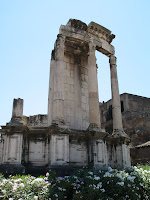
From the hill, we descended into the Roman Forum, another place where description would fail miserably. So, visuals.


We left the Forum, and wandered more of Rome: Capitoline Hill, designed by Michelangelo; the Victor Emmanuel Monument, the massive white structure that Romans call the “false teeth;” Palazzo Venezia, where Mussolini would address crowds in the street from the window above; Trajan’s Column, with a statue of St. Peter where Trajan used to be; the Pantheon, a spot we would come back to every day we were here, and lastly, Trevi Fountsin, where it appeared everyone else in Rome had decided to go, as well. Very crowded little piazza.

We shuffled back to the apartment, and then walked down to the Coliseum area for dinner. However, the restaurant where we wanted to eat was closed (it was supposed to be open, according to their hours). We suspected that the owners decided to focus on the quarterfinal soccer match with Spain that evening. So, we headed to another restaurant that we had been informed of, Trattoria di Quadranto. The pictures on the wall showed that this establishment had been here for at least eighty years, so, we figured that as a good sign.

We learned something very important at this restaurant. Monkey ordered a pasta with a gorgonzola sauce. It turns out she doesn’t like gorgonzola as much as she thought. So, not wanting to leave a full plate of food in front of us, I ate her pasta, and my fried cod (this after a primi, also). I was stuffed!

We had flirted with a night walk, but, after the day's marathon, and my distended belly, we decided that we’d walk to a gelateria (for Monkey—none for me…okay, maybe just a little taste), and then head home. That would be enough of a walk, and we’d save the romantic evening stroll for another time. Like tomorrow, after we got back from visiting the Pope’s house.

Tuesday, July 15, 2008

Tuscanyland! (A Very Long Italian Story, Part Twelve)

Our second day in Siena proved that one learns from experience, as our time spent maneuvering within the city limits and securing a parking space was much reduced from the previous day. Like mice in a maze, we clearly remembered where to go to get the cheese. The cheese in this case being, of course, a parking spot.

We visited some more museums, and were thrilled at the sights of Donatello’s tondo of Madonna and Child (not our contemporary Madonna and her adopted baby, but the Biblical Madonna and her baby, Jesus), as well as Duccio’s Maestra and Passion. The real treat was that we stumbled upon a museum guide/art historian giving a lecture on Duccio’s works. It was enlightening to say the least. I know a little bit about art history, but this was a tour de force of a lecture! And, it was in English—score! Really illuminating.

We also spent a little while in Il Crypta, the remnants of the eighth century church on which the Duomo is built. It was okay. Lots of frescoes and brick arches. Our next stop in Siena was Il Facciatone, the remnants of what was to be the façade of the actual cathedral.

Remember yesterday, I told you about the rivalry between Firenze and Siena? Well, in the 1300s Siena had planned to expand their cathedral, which was completed in the middle 1200s. The gargantuan expanded cathedral would have been many times larger than the relatively large structure that they have now (and waaaay bigger than Firenze's). However, after building the façade, the plague hit Siena, and work was halted, never to be resumed. So, now, they have a giant wall (with a good view), and some white marble pavers to show visitors where the columns would have gone in the Olympic-sized transept of the planned Uber-cathedral.

After some pretty tasty pizza, we headed over to the Oratorio di San Francesco, to visit one last Senesi museum. This one, also a diocesan museum, was loaded with church art, from the 12th century to the 19th. Not bad, though I can’t recall anything that I found particularly breath-taking, here. Then, it was back to the cheese (I mean parking space), to head over to Volterra, via San Gimignano.

We had planned on heading directly to Volterra, having heard that San Gimignano was kind of a tourist trap. At our pizza fiesta the night before, however, we were turned on to a supposedly world-class gelato shop in the town. So, intrigued, we went. As a side note, this area of Tuscany, the sort of northwestern area of Siena province, is well-known (apparently—I didn’t know it) for its alabaster. Thus, if you are looking for some quality artisanal alabaster, head on up to this area. As it turned out, the gelato at the recommended purveyor was four-star. We sampled peanut butter, rosemary-raspberry, pistachio, chocolate, and banana (I think that covers it). We had seconds, it was so good.

I dubbed San Gimignano, “Tuscanyland” (like Disneyland). It really did have a feeling of a this-is-what-Tuscany-is-like-so-we-hope-you-enjoy-it-would-you-like-to-buy-some-alabaster-or-a-T-shirt-that-looks-like-a-Renaissance-style-doublet? I sort of felt like I had strolled into a Renaissance festival, Italian-style. I would not have been surprised if someone in full Medici garb came wandering down the via with his entire retinue, including a juggling dwarf and a prancing minstrel with a lute.

The drive out to Volterra was a bit longer than we bargained for, but, it was a good side trip. We got to see the first Roman ruins of our adventure, a theatre. Unfortunately, as we arrived at about 5pm, the site was closed, but, fortunately, it is readily visible from the street, and the woman at the ticket booth did let us stand on the overlook inside the grounds (for free). We had a gander at a few other sites of Volterra (Etruscan walls, churches, you know), then headed back to Pienza where we hoped to dine at Latte di Luna again.

But, no such luck. As we approached the restaurant, there, on the sign outside, was a note: “Completo.” No room at the inn. We spun around in a circle a few times, not wanting to admit that we had only one other choice: the restaurant just up the street, Trattoria di Baccus (or some such). It was good enough fare, but Monkey was pretty disappointed. The moral of this story, when you go out to eat in a town with two restaurants, make reservations!

Friday, July 11, 2008

This Way to the Best Meal Ever (A Very Long Italian Story, Part Ten)

I remember that the day I am about to write about is a Tuesday, so, if my calculations are correct, we still have over a week to go. As we are now relaying part ten, two things have already or are about to occur. The first, that this is the longest "Very Long" story I have told (there have been two others), and, after this installment, I can no longer count the number of the part in Italian (eleven is tricky, for me).

On this fine Tuesday, we headed north, first to a nearby former abbey, known as Sant'Anna in Camprena. Only a few kilometers from our vacation house, this abbey was a location for the film The English Patient. This explains why there are pictures of Ralph Fiennes eating in the restaurant where we had dinner in Pienza. The main attraction of the 14th century abbey, however, which is currently very nice-looking B&B, is a small room off the courtyard that contains five-hundred-year-old frescoes by Il Sodoma. The grounds are attractive, as well, and the proprietors of the inn are kind enough to allow visitors to wander the grounds during posted hours.

From Sant'Anna, we drove further north, visiting the very small town of Castelmuzio and then proceeding through the area known as Le Crete to another abbey at Monte Oliveto Maggiore. The skies were a bit gray as we arrived at the abbey, but the rain had held off. Unfortunately, the abbey was on siesta until 3pm, so we headed further north to the town of Asciano.

The drive from Castelmuzio north to Asciano was excellent, the hills revealing spectacular vistas. The only disappointment was the lack of sunshine, which would have made for some beautiful pics. Asciano, itself, however, was not so excellent. We wandered around for a while to kill time, and grabbed some pizza and foccacia for lunch, but the town was, compared to other central Tuscany towns, not very attractive.

Back at the abbey, we entered the grounds over a drawbridge (no longer drawable, it appeared, but still pretty cool), and then had a nice tree-shaded walk to the abbey proper. Within the walls, a small chapel captured our interest, along with a double column of large ants making their way down the trunk of a tree, over about twenty feet of ground, and up the front wall of the chapel, where they disappeared over the edge and onto the roof. Ant prayer services?

The abbey itself was fantastic, its courtyard decorated with more Il Sodoma frescoes of the life of Saint Benedict. While we were there, something like a fire alarm was going off, but, the sexton seemed to be telling everyone that it was just a false alarm, and nobody else seemed too concerned, so, we just made our way through the courtyard. Inside the church, we were treated to another set of monks that were doing their prayers in the manner of Gregorian chant. That was unexpected, and, perhaps due to a different scent of incense, or the ostentatiously baroque architecture of the church, I had nowhere near the same sort of experience here as I had at Sant'Antimo.

We headed back to the pad to get ready for dinner at Poggio Antico, where we had made reservations a few days before. As we sat down to eat, the skies opened up. We sat near a window, watching the rain come down, robbed of the evening view that, according to the maitre d' stretched, on clear days, to the sea. At the restaurant, we noticed that the whole evening, no one else entered the restaurant. We were the only diners. This night, Italy was playing someone for the chance to get to the quarterfinals of the European Cup. Our waiter claimed that that was keeping people home. After further experiences with soccer in Italy, I came to believe him.

At any rate, we enjoyed the attention of the entire restaurant, as we enjoyed what turned out to be, perhaps, the best meal we had ever had. We started off with an excellent Rosso di Montalcino (2006), and were treated to some excellent homemade breads. I greatly enjoyed my primi, a tagliatelle with vegetables, but the high point of the meal, for me, was a dish called peposo, a heavily peppered stew, really, served, in a more modern twist, over pureed potatoes and cream. It was spectacular. Monkey had some excellent dishes, too, a three meat ravioli in brasata and gnochetti with lamb.

The attentions of the wait staff were a nice treat, too, and the maitre d' was such a personable fellow. We spent a good portion of the evening joking and talking with him (mostly in English, of course). Monkey was especially excited, as we left that evening (after the rains, and two hours later), to meet the chef, who was sitting at the front of the restaurant, since, I guess, he only had the two of us to cook for, and we were done.

At the house, we turned on our tiny TV (the first time since we'd arrived in Italy) to see the outcome of the soccer match (il calcio, the Italians call it). Italy had won, and they were going to play in the quarterfinals. That would be Sunday night. We'd be in Rome by then. But first, we were off to Siena in the morning, and a rendezvous that evening with some old friends from CoMo, believe it or not.

Wednesday, July 09, 2008

In the Footsteps of John Paul II and Killer Hamsters (A Very Long Italian Story, Part Nine)

Our next Tuscan destination, Cortona, took us about as far west as we would go in Italy, and introduced us to many Etruscan wonders. But first, we met a couple of Jayhawks at breakfast. Imagine, travelling halfway around the world to meet people that live about a hundred miles away from you. Strange, really.

But enough of our domestic neighbors. On to Cortona, a town much larger than any we visited the day before, and, it seemed to us, much steeper and higher. We parked on the street at the foot of the Public Gardens, which was really just a shaded park with gravel on the ground and walked a short distance to the Piazza Garibaldi, trying to use one of our guides to walk us through the town. It was a relative success.

The view from Piazza Garibaldi was big, but nothing compared to later views we would get from a higher vantage point. Frances Mayes, the writer of Under the Tuscan Sun lives in the area of Cortona. If you're ever in Cortona, and you're interested, according to our guide, her villa is behind a hill to the left of the view from Piazza Garibaldi. For me, not the most fascinating tidbit of info. I liked the hill, regardless of whose villa is behind it.

The one thing you notice during the first half of your visit to Cortona: you are always walking up. Steeply. From the main piazza, we found some level ground within the walls of the Etruscan Museum. We spent a couple hours in here, looking at clay pots, jewelry, helmets, weapons, rocks, mosaics, and various interpretive videos whose effectiveness was diminished due to our own ignorance of Italian. In addition, this museum also had some works by Severini, a son of Cortona, who gained some fame in the early 20th century as an artist and critic. The coolest thing in the museum, however, was a heavily decorated oil lamp from the 4th century BCE.

Our next stop was Santa Margherita, which is at the penultimate point of the town. As we made our way higher and higher, climbing along switchback steps that seemed to wind through neighborhoods and nowheres, we came across a marker that stated that Pope John Paul II had made this trek in the 1990s. I was impressed. I'm pretty sure they didn't roll the Popemobile up there, and, unless he was ported up in a rickshaw or on a pillow-laden platform, then, he was one fit old pontifus maximus. Of course, in my mind, it is more than likely that he reached the church on the back of some poor, yet infinitely grateful local, huffing his way up the rocky stairway, bearing his heavy-robed burden, and imagining himself on the white-lighted stairway to Paradise, a beaming Saint Peter standing next to an overcome-by-pride Saint Margaret waiting to punch his ticket and welcome him aboard. But, that's just my speculation. The church is not the town's cathedral, but the residents spend most of their time and money on the beautification and decoration of this church, because Margherita is a home girl. It is a very beautiful church, and choc-a-block full of Margherita relics.

From here, we did some backtracking (mercifully downhill), had some pizza, and visited the cathedral (not very impressive next to Margherita's final resting place) and the Diocesan Museum (you know, these church folk got some damn nice art). The museum is mostly the structure of another church (Chiesa di Gesu), reconstructed and with additional pieces from the diocese. Highlights included an Annunciation by Fra Angelico, an elaborate baptismal font, some stations of the cross by Severini, and a wonderfully frescoed lower chapel.

In Cortona, we did the same thing as the day before in Montepulciano, buying some local stuff to eat with the remainder of our pasta and cheese. We brought home a bottle of Cortona Sangiovese, but, we didn't like that quite as much as the previous night's wine.

That night, as I sat on the veranda, a fox walked right past me. I thought that was a nice sight. However, a few moments later, I spied the tiny head of an unidentified animal poke out of the bushes around my chair and seem to look up at me. I looked down at him, and he seemed to be unfazed by my presence. I decided to take that as a hint that it was time for me to go inside and go to bed. This unidentified mammal was dubbed, "The Wild Hamster of Pienza." This later became, after time and the predictable hyperbole that accompanies an unidentified anything, "The Killer Hamster of Pienza." So, future travellers of the Pienza area: beware the killer hamster!

Sunday, July 06, 2008

Little David, Big Gardens (A Very Long Italian Story, Part Six)

We started our final day in Firenze at the Bargello, another museum of note. Housed in another old palace, this museum is home to sculptures, sculptures, and more sculptures. Perhaps the most important piece at the Bargello is Donatello’s David. Different in every way to Michelangelo’s, Donatello’s sculpture is bronze, about five feet high, and portrays David as a more traditional, slight, boy. The smaller David still has an air of confidence about him, but the earlier Donatello possesses little of the majestic awe that Michelangelo’s seventeen-foot masterpiece does.

Another difference between the big David and the little David: the little David was being restored while we were there, so all we got to see was the statue, face down on a bench, behind a fence that protected that separated the restoration from the general museum-going population. Of course, they were making a big deal about the restoration, with video displays, and pamphlets, and a museum worker answering questions behind the fence, and, it was unusual to actually see them doing the restoration (which consisted, as far as we could see on that particular day, of dripping some weak acid on a tiny portion of the bronze and then rubbing it with a Dremel (yes, Anon AMVB, a Dremel)) right there on the museum floor, but, I really would have liked to seen the thing upright and on display…oh well, I guess we’ll just have to go back.

Our exit from the Bargello was delayed by a short downpour, which we watched from the balcony that overlooked the courtyard, but after that was over, we headed out in search of a suitable lunch facility.

We snagged a couple of foccacia sandwiches at a nearby bar, and then decided to head up to Santa Croce, former home to Fra Angelico and Savanorola. The monastery is loaded with Angelico frescoes that are, so we heard, remarkable. However, Santa Croce closes at 2pm. We got there at 2:20. So, not frescoes for us. We wandered around some parts of town where we hadn’t been, and stumbled on a neat little piazza around the art school, then, we decided to head to Boboli Gardens. It was a pretty day, no rain, and we felt like some outdoor activity would be a nice change of pace to our museum overload of the last few days.

The gardens are huge. We covered about a quarter of them in three hours. We also got to check out the porcelain museum (it’s everything you might expect). My favorite part of the gardens was the Isolotta, a large water feature, with sculptures and fountains. We spotted a grey heron (a European relative to the great blue hereon of North America) at the Isolotta, and a lady feeding the hundred cats that wander the gardens on our walk to the Isolotta.

It’s not much of a garden in the way of blooming flowers and such. I guess it’s more of a walking-around-‘cause-your-rich-and-you-got-nothing-to-do-all-day kind of garden (after all, this too was owned by the Medicis, and they were rich, and most of them had little to do all day, I imagine, except the ones that were popes and cardinals and governors and such, but that leaves a big Medici remainder, really). That said, it was one of the most enjoyable parts of our visit to Firenze, most likely because we were outside.

The only disappointment on this leg of our journey was our inability to find the silver museum, which, like the porcelain museum which held a mess o’ Medici porcelain, held a number of shiny Medici services. Monkey really wanted to see the silver museum; however, by the time we found it, it was closed. So, we hoofed it on back to the pad to shower up for dinner at a place we’d read about in the New York Times. I forget what it was called, but it was okay. After one last Florentine gelato, it was back to the B&B to ready ourselves for a big shift in our Italian extravaganza. Tomorrow morning, we were renting a car and driving the Italian countryside!

Wednesday, July 02, 2008

What Would Papa Think? (A Very Long Italian Story, Part Five)

With no prior experience as a European traveler, most of my notions of Europe, for better or worse, come from Ernest Hemingway. The Sun Also Rises, A Farewell to Arms, For Whom the Bell Tolls—these were my blueprints for Europe. So, in some way, I imagine Firenze, prior to my arrival, as a place firmly stuck in an era of history that was, at least, eighty years ago. I also imagined myself strolling through it, a suave, hardened man of experience, ordering caffe and grappa from a corner bar, and reading the local leftist paper while I smoked away the morning. Other expatriated Americans would come and go, including Monkey, of course, as we whiled away the day until a late supper found us all gathered around a red-checked table in a tiny eatery, loudly debating local, national, and international politics, surrounded by bottles of wine and more grappa, tearing loaves of bread with our hands to sop up the greasy gravy of a local stew. And of course, the days would be brightly lit by a merciless sun, the evenings would seem eternally crepuscular, and the nights would be candlelit.

And, I guess, some of that came to pass. But first, we had a major museum to tour.

Let me pause here to apologize for the dearth of pictures that this entry will contain. Taking pictures in museums and churches, where we spent most of our time in Firenze, is generally frowned upon. Where it is not strictly vietato, use of a flash is clearly not acceptable. Thus, even were we able to take pictures, which we tried to do where we could, the increased exposure times made taking decent pictures difficult for two folks with limited camera skills (i.e., the Monkeys). So, until we get outside (tomorrow, really), the photojournalism is limited at best. Now, back to the show.

The Accademia is not a very big space. I believe it is part of an art institute in Firenze. It has two floors, the second of which is relatively tiny, and contains some really impressive fourteenth century triptychs and polyptichs and other devotional art in all its gilded two-dimensional glory. The first floor, while also not large, does have the irresistibly attractive centerpiece known as David.

Before one reaches David, however, a long hallway is home to other works of Michelangelo, namely, The Slaves, four unfinished pieces intended for the tomb of a megalomaniacal pope. The power of these pieces is undeniable, but, we found it interesting, in overhearing a tour guide discuss the emotional weight of these figures struggling to break out of the unfinished marble, that the interpretation of the pieces hinges on an accident. As far as Monkey and I can discern, the artist had every intention of finishing these figures. If that’s the case, can their unfinished nature be included as part of one’s interpretation of the pieces? It’s an interesting question to ponder, I think, and one that gets to the heart of meaning making and the role of the artist and the observer in that transaction. But enough about these little unfinished blocks of stone: look down the corridor there, and what do you see, looming three times larger than life itself? The anatomical perfection of David, contemplating his task and clearly certain of his victory.

Everyone has seen pictures of this immense (in size and significance) figure, but seeing it in person, as it fills the atrium of this small gallery, being able to circle it and look at it from many angles and in changing light, is an experience that really can not be described. You just have to see it, really. It’s a beautiful thing.

The remainder of the museum’s first floor is exciting enough, with some wonderfully large Renaissance canvases, but after the centerpiece, the rest is nearly just decoration.

After several hours in the Accademia, the pattern from yesterday was repeated, as we rested up for about an hour at the B&B, and then headed to a little place called Ichee ch’e ch’e (or something along those lines, spelling wise), which translates to “whatever is, is,” for dinner. Without reservations, we were seated in the center of the restaurant at a long “family style” table. Let me tell you something: in general, I hate eating “family style” (unless I am, indeed, with my own family, and, even then, I don’t always enjoy it so much, you know?). We were seated next to a couple, who were seated next to a single hippy. It turns out that the couple next to us were on their honeymoon from New York, and the hippy was a freshly minted high school grad from Cali. As we ate, another couple came in and sat next to us. We recognized them from breakfast. They were staying at the same B&B as we were. They were from Minnesota (via Omaha, believe it or not).

So, in true, Hemingwayesque fashion, we passed the eternal twilight around a red-checked table, a small tribe of very temporarily “expatriated” Americans, drinking wine, sopping up gravy and ragu, and debating, if not the future of the recently installed Italian government, at least the merits of nearby gellaterias.

Tuesday, July 01, 2008

The Marauding Pigeons of Firenze (A Very Long Italian Story, Part Four)

An overcast day in Firenze greeted us as we dined on cereal at the B&B. Our host, Bruno, offered us an umbrella, and we took him up on it. We had afternoon reservations for the Accademia Museum, so we decided to fill our morning with more reliquaries and, perhaps, some shopping.

Our first stop was the Chapel of the Medicis, near San Lorenzo. There was a small admission charge, as there seemed to be at every place we went in Firenze (except the Duomo). Inside, the first floor was non-descript, and hard to figure out, since they provide little in the way of interpretive signage or literature, either in English or Italian (or French or German, for that matter). We managed to figure out that we were in a large room that housed the tombs of at least two dozen lesser lights of the Medici clan. And, of course, around the room, in vitrines for display, the gleaming wealth housing the bones of the saints.

Speaking of saints, this trip, among many things, opened Monkey’s and my eyes up to the fact that we don’t know much about the saints of the Catholic church (nominally, our faith of heritage). Granted neither of us are practicing Catholics, and I, myself, am dedicatedly unreligious, maybe even unspiritual (I have been accused of being “dead inside”), but, in our youths, we got quite a bit of schooling and indoctrination in the faith. However, on this trip, it was clear to us that these Italian Catholics are major league players. By comparison, we were, even in our Communion-taking heyday, no better than a traveling squad of barnstormers, playing state fairs for half the gate (okay, maybe a bad sports analogy, but, this is my show).

Case in point: Saint Zenobius. Who? Exactly. But this guy was everywhere. Every church had a fresco, or a polyptych that either took a Zenobian miracle as its subject, or included the man in the line up of admirers of Madonna con Bambino. We had never heard of this guy. This seemed like a huge gap in our knowledge. After all, if the guy cured the blind and raised the dead, and, as we learned, always won the bike in the conversion drive at his grade school, why hadn’t we heard of him? Especially since Italy seemed to be crawling with propaganda celebrating his triumphs. Well, here’s why: it turns out, he is a native of Firenze (born and raised in the 3rd century or so). He’s the patron saint of the town. Another bad sports analogy? St. Zenobius is to Firenze as Cal Ripken is to Baltimore. So, while he IS the Mack Daddy of Firenze, outside of town, he’s just a minor saint. He looks good in a miter, though.

Now, as I said earlier, the Medici Chapel is pretty plain on the first floor. I was surprised by this. We’re talking about one of Firenze’s greatest families, the clan responsible for some of the best (and worst) moments in medieval Italian history, some seriously wealthy folk. What was up with this cement and brick snooze-fest of a chapel? The answer, my friends, was just up that little stairway to the back of the building. Shall we?

At the top of the stairs, Monkey and I walked into a chapel of grand magnificence (you know, not just regular magnificence). Walls, ceilings, floors were all gleaming black marble with colorful inlaid designs and crests and such. The chapel held six tombs of the big name Medicis, and each tomb was more ornate than the last, and, atop each, a larger-than-life marble statue of the deceased. Ostentatious, as well as impressive. Behind the altar, in the sacristy, were a few displays of priestly garb and equipage, as well as a few dozen more reliquaries. But, in another chapel, just down the hall, there was more to see.

Another small chapel, this one in white marble, held the tombs of Lorenzo Medici and his brother Giuliano, each topped with a pair of statues sculpted specifically for the purpose by Michelangelo himself. In all, the four statues represented Dawn, Day, Twilight, and Evening. And with that, this was clearly the Medici-style chapel I expected to see.

Leaving the chapel, we wandered to the steps of the nearby San Lorenzo church, where we planned our lunch strategy: after wandering through the open air market in the piazza, we would peruse the nearby central market and buy some bread and cheese and fruit, and have a little picnic on the steps of the church. This was a great plan that started off without a hitch, as we bought some cherries and some cheese and a loaf of bread, but, as we sat down to eat, we were immediately surrounded by every pigeon in Tuscany. We packed up our stuff in a rush and moved down to a different location, across the street and down a little way from the piazza, but, after only a few moments, the flying rats found us, again. We grabbed our stuff and headed to the museum, not knowing where or how we would eat. (By the way, I don't know why this photo is oriented this way, I've rotated it on my hard drive, but it keeps popping up here in an un-rotated fashion. Any suggestions as to why, technophiles?)

After nibbling on a bit of bread and cheese while standing outside the museum, I decided to walk the remainders of our meal back to the B&B, where it could wait for us when we returned. I didn’t want to have to schlep our groceries through the museum. So, a quick-footed 25 minute round trip brought me back to the Accademia, where we prepared to be awed by the large hands of David.

Monday, June 30, 2008

Seven Hundred Years Ago, I'd Have Been Neighbors with Dante (A Very Long Italian Story, Part Three)

Our apartment, on an alley-like side street in Firenze, was nestled amongst a fine pasticheria and restaurant, a few shops, and a residence or two. Just a few housefronts to the east, on the corner, stood a structure that claimed to be the home of Dante Aligheri, Firenze's most famous literary son. I thought it would be an excellent opportunity, to tour the house of the author of the Divine Comedy, but, upon further investigation, Monkey and I discovered that the house was actually built in the 1970s, in the style of a 14th century Fiorentine house, on the foundations of Dante's house. We'd found our first tourist trap! We took it as enough to say that we were dwelling on the same street and, perhaps, trodding some of the same cobblestones as the great writer. We did not visit the Dante simulacrum.

However, on our first full day in Firenze, after a small breakfast of cake and coffee at the apartment, we were off to adventure and a trip back in time to Renaissance Italy! First, we returned to the Duomo, which we had perused from the outside the day before. With its accompanying Baptistry and Campanile, this Renaissance cathedral is the pride and joy of Firenze. After all, even if every semi-major town in the region has a cathedral they might call the Duomo (which just means "house of God"), few have such a magnificently realized, domed cathedral, and Firenze has the first octagonal dome built without the use of any scaffolds!

In addition to the architectural marvel of the cathedral, which also hosts some amazing sculptural work inside and out and a beautiful fresco inside the dome, the Baptistry, just across the piazza, is bedecked with gilded bronze doors sculpted by Ghiberti over the course of 21 years in the middle of the 15th century. Of course, the doors currently on the Baptistry are replications. The originals, after being restored, are displayed in the Opera del Duomo Museum, just across the street from the Cathedral (we'll visit there, later).

After spending the early morning inside the Duomo and outside the Baptistry, we walked around deciding what to do next. We had several hours to kill before our 2pm reservations at the Uffizi Gallery, so, we thought we'd warm up for that museum inside the previously mentioned Duomo Museum.

The Duomo Museum contains (as you may have gathered) many of the works from the Duomo and related buildings. Modern Italy has been hard on marble statues left out for five hundred to seven hundred years decorating building facades, so, they've gathered many of them, restored them, and brought them inside various museums. The Duomo Museum, which is located in what used to be the workshops for sculptors of the Duomo's facade and other decorative structures, is unique for another reason, also. Michelangelo's David, which used to reside in Firenze's Piazza del Signori, was scuplted in the courtyard of this workshop. Everywhere, the footprint of art and history.

The museum housed some pretty cool stuff, including the Pieta that Michelangelo sculpted for his own grave. The freakiest thing we discovered was a number of reliquaries, which are ornate silver and gold boxes, with glass windows in them that house the bones of saints or pieces of the cross upon which Jesus was crucified (at least, that's the claim). It was equal parts cool and creepy, looking at the leg bone of Saint What's-his-face, but it was nothing compared to some later morbid sights of Christianity (stay tuned!). We saw quite a number of these reliquaries over the course of our trip, probably somewhere in the hundreds, but this was our first real look at them. They are very beautiful things. They just hold thousand-year-old bones. Momento mori, baby.

We were then off to the Uffizi, the home of Botticelli's Birth of Venus and Primavera (Spring) , among other masterpieces. The museum used to be the offices of the Medici's, the ruling family of Florence. It became a public museum in the 1700s. It is an interesing building, as well as a museum, with long corridors and lovely views of the river and city. A museum highlight for me: Artimesia Gentileschi's Judith Slaying Holofernes. It's sort of down in the basement, almost at the end of this long room of seemingly random stuff. But, it's such a beautiful painting. The colors in it really jump out at the viewer. The action in the work is so brutal, but the colors and the use of light make it so beautiful, it's captivating. Why they have this gem stuffed down in the basement, I don't know.

After nearly four hours at the Uffizi, we paused at the casa and then were off to dinner at La Giostra, another Monkey-certified recommendation. It was awesome, people. I know Monkey will read this and think that I skimped on the meal's details, but, it's enough for me to say that I had some kick ass spinach ravioli, and Monkey had a spectacular papardelle with ciangale (boar) ragu. Also, the complimetary antipasti plate, filled with crostini and bruschetta and prosciutto and such--wow! It was a great meal.

More gelatto, at a place called Vivolui (chocolate and pear, I think), which was not as good as the first. Then, it was prep time for tomorrow's big museum, the Accademia, current home of Michelangelo's gigantic masterpiece, David.